
Maharaja Sayajirao University of Baroda – Faculty of Law
Description
About Maharaja Sayajirao University of Baroda – Faculty of Law
Verified by Lawsection.in Editorial Team | Updated: May 30, 2026
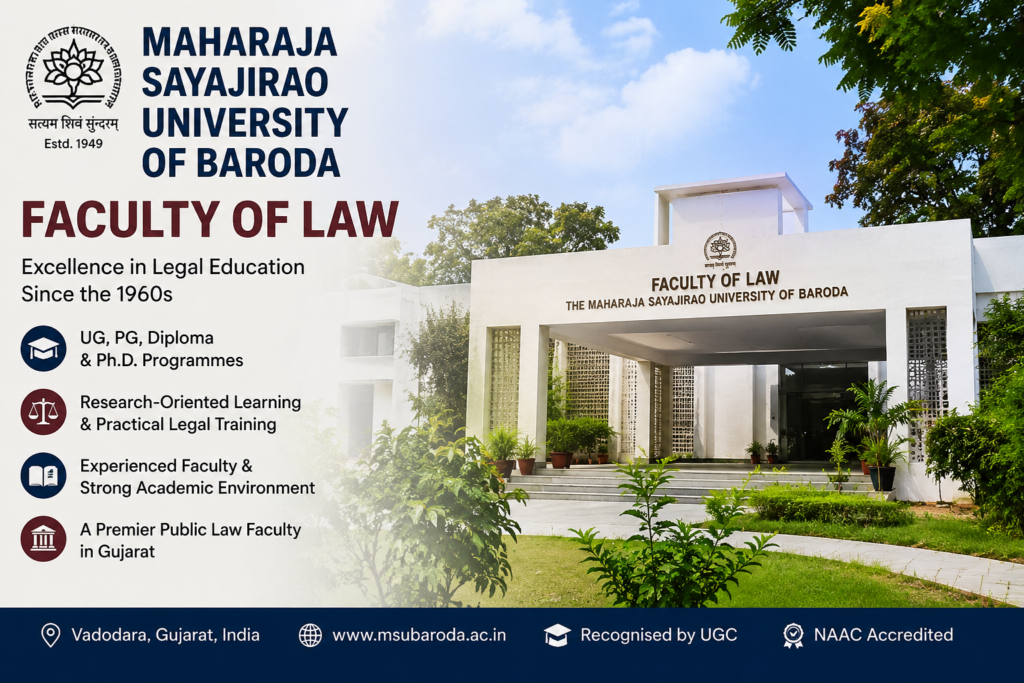
The Faculty of Law, The Maharaja Sayajirao University of Baroda (MSU Baroda) is one of Gujarat’s established public law faculties and has contributed to legal education, legal scholarship, and research in Gujarat for several decades. Located in Vadodara, Gujarat, the Faculty functions under The Maharaja Sayajirao University of Baroda, a public state university established in 1949. The Faculty of Law has been a recognised centre for legal education and legal studies in Gujarat since the 1960s.
The university is recognised by the University Grants Commission (UGC) and operates as a public state university established under the Maharaja Sayajirao University of Baroda Act, 1949. The Faculty of Law offers legal education through undergraduate, postgraduate, diploma, and doctoral programmes. In addition, the law programmes are conducted in accordance with applicable regulatory requirements and university regulations.
Moreover, the Faculty is known for its emphasis on legal scholarship, contemporary legal studies, research-oriented learning, and practical legal training. Students benefit from academic resources such as the law library, seminar facilities, moot court exposure, and interaction with legal professionals.
Because Vadodara is an important educational and cultural centre in western India, the Faculty attracts students from Gujarat and other regions who seek affordable public legal education with a strong academic foundation.
University Snapshot
Location
Vadodara, Gujarat, India
University
The Maharaja Sayajirao University of Baroda
Established
1949 (University)
Faculty of Law Legacy
Recognised as an established centre for legal education and research in Gujarat since the 1960s
Type
Public State University
Campus
University Campus, Sayajigunj, Vadodara, Gujarat
Official Website
https://msubaroda.ac.in/academics/FOL
Main Law Programmes
LL.B., B.A. LL.B. (Hons.), LL.M., Ph.D., and Postgraduate Diploma Programmes
Main Intake Cycle
Generally July–August, subject to university notifications
Law Programmes Offered by MSU Baroda Faculty of Law
The Faculty of Law offers undergraduate, postgraduate, diploma, and doctoral programmes designed to provide both academic knowledge and professional legal training.
B.A. LL.B. (Hons.) – Integrated 5-Year Programme
Duration: 5 Years
Eligibility: As prescribed by the university admission rules applicable for the relevant academic session
Mode: Full-Time
LL.B. (General)
Duration: 3 Years
Mode of Admission: Entrance Test as notified by the university
Intake Capacity: 240 Seats (as per published programme information)
The programme is intended for graduates seeking professional legal education and eligibility pathways toward legal practice subject to applicable Bar Council regulations.
LL.M. Programme
The Faculty offers LL.M. specialisations including:
1: Business Law
2: Criminal Law
3: Constitution and Legal Order
4: Environment and Legal Order
Ph.D. in Law
Duration: As per university Ph.D. regulations
The doctoral programme is designed for advanced legal research and academic scholarship.
Postgraduate Diploma Programmes
The Faculty also offers specialised diploma programmes, including:
1: Post Graduate Diploma in Taxation Practice
2: Post Graduate Diploma in Labour Practice
Recognition and Institutional Status
The Faculty of Law operates under a recognised public university framework and forms part of one of Gujarat’s established state universities.
Key Recognition Details
- The Maharaja Sayajirao University of Baroda is a recognised public state university.
- The university functions under the Maharaja Sayajirao University of Baroda Act, 1949.
- The university is recognised by the University Grants Commission (UGC).
- The Faculty of Law offers legal education programmes in accordance with applicable university regulations and relevant legal education requirements.
- The university operates within the recognised higher education framework applicable to public state universities in India.
- The institution participates in national academic ranking and assessment frameworks.
Furthermore, the Faculty benefits from being part of a long-established public university system. Consequently, students gain access to a structured academic environment and diverse learning opportunities.
Why MSU Baroda Faculty of Law Stands Out
The Faculty of Law distinguishes itself through a combination of academic heritage, public university affordability, and legal research engagement.
Furthermore, the Faculty regularly focuses on emerging legal developments and contemporary legal education. Its academic structure encourages students to develop analytical reasoning, legal writing skills, research abilities, and advocacy competence.
In addition, students gain access to:
- Dedicated law library facilities
- Seminar and academic discussion platforms
- Research-oriented learning
- Moot court and advocacy exposure
- Experienced legal faculty members
- Academic engagement opportunities through the Centre for Intellectual Property Rights (IPR)
- Academic engagement opportunities through the Centre for Alternative Dispute Resolution (ADR)
Additionally, the Faculty supports specialised academic engagement through its Centre for Intellectual Property Rights (IPR) and Centre for Alternative Dispute Resolution (ADR). These centres promote awareness, research, and discussions in specialised areas of legal practice and scholarship.
As a result, the Faculty continues to attract students interested in legal education, judiciary preparation, postgraduate legal studies, and research-oriented academic pathways.
Faculty, Research and Academic Environment
Research remains one of the important strengths of the Faculty of Law.
The Faculty encourages legal scholarship through postgraduate studies, doctoral research, seminars, academic discussions, and specialised legal programmes. Faculty members engage with contemporary legal issues and evolving legal trends, thereby helping students develop deeper academic understanding.
Additionally, the Faculty offers academic infrastructure that supports legal research, including library resources and seminar facilities.
Moreover, students regularly engage with academic discussions, seminars, and research-oriented activities. As a result, they develop stronger analytical abilities, legal reasoning skills, and academic understanding.
Therefore, students interested in legal academia, public policy, judicial services, and specialised legal practice often consider MSU Baroda a suitable academic environment.
Who Should Choose MSU Baroda Faculty of Law?
This institution may be particularly suitable for:
- Students seeking affordable public legal education in Gujarat.
- Aspirants preparing for judiciary and competitive legal examinations.
- Candidates interested in postgraduate legal studies and research.
- Students looking for established public university credentials.
- Individuals interested in legal scholarship, policy studies, and academic careers.
- Graduates seeking a recognised LL.B. pathway toward legal practice in India.
Career Pathway After LL.B. in India
Step 1 – Complete an Eligible LL.B. Programme
Successfully complete the LL.B. programme from the university in accordance with applicable academic requirements.
Step 2 – State Bar Council Enrolment
Apply for enrolment with the appropriate State Bar Council under the provisions of the Advocates Act, 1961, subject to eligibility requirements.
Step 3 – All India Bar Examination (AIBE)
Qualify the All India Bar Examination conducted by the Bar Council of India as applicable.
Step 4 – Certificate of Practice
After satisfying regulatory requirements, candidates may become eligible to practice law in India.
Students should always verify the latest Bar Council of India regulations and enrolment requirements before making career decisions.
Reputation and Academic Standing
The Faculty of Law has developed a longstanding reputation within Gujarat’s legal education ecosystem.
Its reputation is supported by:
- Association with a public state university established in 1949.
- Legal education legacy dating back to the 1960s.
- LL.B., LL.M., diploma, and doctoral programmes.
- Research-focused academic environment.
- Student participation in legal competitions, academic activities, research initiatives, and judicial service examinations.
- Continued engagement with contemporary legal education and academic development.
Documents Commonly Required for Admission
Applicants may generally be required to submit:
- Academic mark sheets and transcripts
- Degree certificate (where applicable)
- Entrance examination documents, if applicable
- Government-issued identity proof
- Passport-size photographs
- Category certificate, if applicable
- Migration certificate, if required
- Passport and visa documents for international applicants
- Additional documents as specified in the admission notification
Students should always verify document requirements from the official admission notification for the relevant academic year.
Admission Process at MSU Baroda Faculty of Law
Admission procedures may vary by programme and academic session.
General Admission Steps
- Visit the official MSU Baroda Faculty of Law website.
- Select the desired programme.
- Review eligibility requirements carefully.
- Complete the online application process.
- Upload required documents.
- Pay the prescribed application fee.
- Appear for the entrance test if required.
- Check merit lists and admission notifications.
- Complete document verification.
- Confirm admission within the prescribed deadline.
For the LL.B. programme, admission is conducted through an entrance-based process as notified by the university.
Finally, applicants should carefully review the latest admission notifications before submitting their applications. Likewise, they should ensure that all required documents are uploaded within the prescribed deadlines.
Frequently Asked Questions (FAQs)
1. Is the law degree from MSU Baroda valid for legal practice in India?
Eligible LL.B. programmes offered by the Faculty of Law are conducted under the university framework and applicable legal education regulations. Graduates should verify the latest Bar Council of India enrolment requirements and AIBE eligibility criteria before pursuing professional practice. After completing an eligible LL.B. degree, graduates may pursue enrolment with the relevant State Bar Council and appear for the All India Bar Examination (AIBE), subject to the latest Bar Council of India regulations.
2. Is admission to the Faculty of Law at MSU Baroda difficult?
Admission can be competitive because the Faculty attracts applicants from across Gujarat and other states. The selection process varies by programme and academic session. Therefore, candidates should carefully review the latest eligibility criteria, admission notifications, and entrance requirements published by the university.
3. Is MSU Baroda Faculty of Law a good choice for judiciary and government exam preparation?
The Faculty provides a strong academic foundation in core legal subjects and emphasises legal research, analytical reasoning, and legal scholarship. These attributes may support students preparing for judiciary examinations, UGC NET, civil services, and other legal competitive examinations.
4. Does MSU Baroda offer affordable legal education compared to private law colleges?
Generally, yes. As a public state university, MSU Baroda is often considered a more affordable option than many private law institutions. However, tuition fees and other charges may change over time, so applicants should always verify the latest fee structure from official university sources.
5. Should I choose MSU Baroda Faculty of Law or a private law university?
The answer depends on your academic goals, budget, and preferred learning environment. Students seeking affordable public legal education, an established university reputation, and strong academic foundations may consider MSU Baroda among their available options. On the other hand, some students may prefer private institutions for different campus facilities, specialisations, or placement ecosystems. Comparing curriculum, costs, faculty, location, and career objectives can help you make an informed decision.
Study LLM Abroad: Top Law Universities in UK, USA & Canada
Planning to pursue an LLM abroad? Explore carefully curated and verified guides to top-ranked law universities in the United Kingdom, United States, and Canada. These country-wise pages provide structured information on admission requirements, eligibility criteria, tuition fees, intakes, scholarships, and career prospects — based on official university sources and updated as of 2026. Compare destinations confidently and choose the best pathway for your global legal career.
LLM In UK

Find the best Law Universities in United Kingdom.
LLM In USA

Explore Top-ranked Law Universities in the USA.
LLM in Canada

Canada’s Top-ranked Law Universities listed here.
This information is curated by Lawsection’s editorial team as part of our Study Law Abroad and Global Law College Directory initiatives.
Information in this profile is based on publicly available information published by the Faculty of Law, The Maharaja Sayajirao University of Baroda, and other relevant university sources available at the time of editorial review.
Content reviewed using official university sources and publicly available institutional information. Prospective students should verify admission requirements, fees, eligibility criteria, programme structures, and regulatory requirements directly from the official university website before applying.
Address







Cardiff Metropolitan University, UK – Law Courses, Fees, Eligibility, Admissions 2026
- Government
- LLB (3 Years), LLM Abroad, Juris Doctor (JD), PhD in Law




Wrexham University Law Courses in UK (2026): Fees, Entry Requirements, Admissions & Student Guide
- Government
- LLB (3 Years), LLM Abroad, Juris Doctor (JD), PhD in Law



Cardiff University, UK – Law Courses, Fees, Admission Requirements & Study Opportunities (2026)
- Government
- LLB (3 Years), LLM Abroad, Juris Doctor (JD), PhD in Law


Swansea University Law School (UK): Courses, Fees, Eligibility, Admissions, Rankings & Study Guide 2026
- Government
- LLB (3 Years), LLM Abroad, Juris Doctor (JD), PhD in Law



Bangor University, UK – Law Courses, Fees, Eligibility, Admissions & Bangor Law School Guide (2026)
- Government
- LLB (3 Years), LLM Abroad, Juris Doctor (JD), PhD in Law



Queensland University of Technology Law School Australia: Courses, Fees, Eligibility, Admissions & Career Opportunities 2026
- Government
- LLB (3 Years), LLM Abroad, Juris Doctor (JD), Doctor of Juridicial Science (S.J.D), PhD in Law



Griffith University, Australia – Complete Guide to Law Programs, Fees, Eligibility, Campuses & Admissions (2026)
- Government
- LLB (3 Years), LLM Abroad, Juris Doctor (JD), Doctor of Juridicial Science (S.J.D), PhD in Law
